
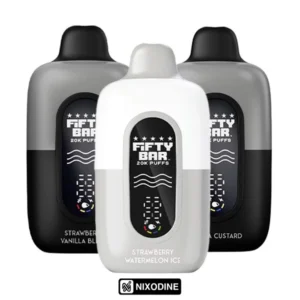
We carry the Fifty Bar 20K in both its standard nicotine version and its Nixodine version Fifty Bar 20K Nixodine, and the question we hear most at the counter isn’t about flavor. It’s about safety. Customers want to know what Nixodine actually is, whether it’s really nicotine-free, and whether that makes it the safer choice.
The honest answer is more complicated than either side of the marketing wants to admit. Nixodine is real, and it does something different from nicotine. But different doesn’t automatically mean safer, and the research on it is much thinner than the packaging suggests.
This guide breaks down what Nixodine actually is, how it compares to traditional nicotine, and what the current research says about which one carries more risk.
TLDR:
- Nixodine is a synthetic compound, not a nicotine derivative, engineered to mimic some of nicotine’s sensations
- It contains zero nicotine and currently falls outside the FDA’s Tobacco Control Act authority
- Nixodine produces less throat hit and is flavorless, which is why flavors taste sharper on the Nixodine version of a product
- There is no long-term safety data on Nixodine, which cuts both ways: no proof of harm, but no proof of safety either
- Nixodine can still activate some of the same receptors involved in nicotine dependency, so it may not be free of habit-forming potential
- Traditional nicotine has decades of research behind it. Nixodine has almost none
What Nixodine Actually Is
Nixodine is a lab-created compound, not something extracted from tobacco. It belongs to a small family of synthetic nicotine analogs that includes compounds like 6-methyl nicotine and nicotinamide, sometimes sold under trademarked names such as NoNic6 or Metanine. Nixodine-S Salts 50, the version used in the Fifty Bar 20K Nixodine, was formulated to match the physical sensation of a standard 50mg nicotine salt disposable.
It works by mimicking part of the physical experience nicotine users expect: a draw sensation, a bit of throat feel, and some sense of satisfaction. What it does not do is deliver nicotine’s addictive chemical compound, at least not in the way traditional nicotine salt does.
What Traditional Nicotine Is
Nicotine salt is the form used in most modern disposables and pod systems, including the standard Fifty Bar 20K. It’s derived from tobacco, and it delivers a well-documented chemical effect. That includes a real throat hit, a fast onset, and a dependency risk that has been studied for decades.
Nicotine’s risks and effects are not a mystery. Regulators, researchers, and manufacturers have data going back generations. That’s a meaningful difference when you’re comparing it to something as new as Nixodine.
Side-by-Side Comparison
Category | Traditional Nicotine | Nixodine |
Source | Derived from tobacco | Lab-synthesized compound |
Contains nicotine | Yes | No |
Throat hit | Strong, well-defined | Smoother, noticeably less |
Flavor interference | Can mute flavor at high strength | Flavorless, flavor reads more clearly |
Dependency research | Decades of data | Minimal to none |
FDA oversight | Regulated under the Tobacco Control Act | Currently outside that authority |
Long-term safety data | Extensive | Does not currently exist |
So Which One Is Actually Safer?
Here’s where we have to be straightforward with you: nobody can say for certain that Nixodine is safer than nicotine. What we can say is what the current research and reporting actually show.
The Case for Nixodine Being Lower Risk
Nixodine contains no nicotine, so it doesn’t carry nicotine’s specific chemical dependency profile or its established cardiovascular and developmental risks. For someone trying to step down from nicotine without giving up the vaping ritual entirely, that’s a real distinction, not just marketing language.
The Case for Caution
Independent reporting, including a doctor-reviewed analysis, points to the same gap: there is no long-term safety data on Nixodine. It hasn’t been evaluated by the FDA the way nicotine products have, largely because it falls outside the legal definition of a tobacco product. That’s not proof it’s dangerous. It’s proof that nobody has done the research yet.
There’s also a dependency question that gets glossed over. Some researchers note that compounds like Nixodine can still activate similar receptors involved in nicotine dependency, which means the “nicotine-free” label doesn’t necessarily mean “habit-free.” The cardiovascular profile is also uncertain, simply because the studies haven’t been done.
Who Should Choose Which Version
Choose Traditional Nicotine If:
- You already use nicotine regularly and want a well-understood risk profile over an unknown one
- You rely on throat hit as a signal that the device is working
- You’re transitioning from cigarettes and want the closest match to that sensation
Choose Nixodine If:
- You want to step away from nicotine specifically, and you understand that Nixodine is not a proven cessation tool
- You’re sensitive to throat hit and prefer a smoother draw
- You want the clearest possible flavor from the e-liquid
- You’re comfortable using a product with limited long-term research behind it
Frequently Asked Questions
Is Nixodine nicotine-free?
Yes. Nixodine contains zero nicotine. It’s a synthetic compound designed to mimic some of nicotine’s physical sensations without delivering nicotine itself.
Is Nixodine safer than nicotine?
It’s not that simple. Nixodine avoids nicotine’s specific, well-documented risks, but it also lacks long-term safety research of its own. Neither product should be considered risk-free.
Is Nixodine regulated by the FDA?
Currently, no. Because it contains no nicotine, Nixodine falls outside the FDA’s Tobacco Control Act authority, which also means it hasn’t gone through the same safety evaluation process nicotine products have.
Can Nixodine still be addictive?
Possibly. Some research suggests Nixodine and similar compounds can activate receptors involved in nicotine dependency, even without delivering nicotine itself. It shouldn’t automatically be assumed to be non-habit-forming.
Can I use Nixodine products to quit nicotine?
Nixodine products are not approved or marketed as cessation devices. Some people use them as part of a personal plan to step down from nicotine, but if you’re working on quitting, talk to your doctor about approaches with proven track records.
Does Nixodine taste different from nicotine?
Yes. Nixodine is flavorless and produces less throat hit, so the e-liquid’s actual flavor tends to come through more clearly compared to the nicotine version of the same product.
Final Thoughts
Nixodine isn’t a gimmick, but it also isn’t a proven safer alternative. It’s a new compound with a specific benefit, a smoother, more flavor-forward experience without nicotine, and a real gap in the research needed to say much more than that with confidence.
If you’re deciding between the two, the honest framework is this: traditional nicotine carries known, well-studied risks. Nixodine carries unknown ones. Which sounds better to you depends on how you weigh a known quantity against an unknown one.
-
 Rated 5.00 out of 5$19.99Select options This product has multiple variants. The options may be chosen on the product page20 point item
 -

 Rated 4.83 out of 5$19.99Select options This product has multiple variants. The options may be chosen on the product page20 point item
